Kidney and blood pressure regulation—latest evidence for molecular mechanisms
Kidney and blood pressure regulation—latest evidence for molecular mechanisms
Yoko Suzumoto 1,✉, Laura Zucaro 2,3, Anna Iervolino 4,5, Giovambattista Capasso
Clin Kidney J. 2023 Jan 24;16(6):952–964
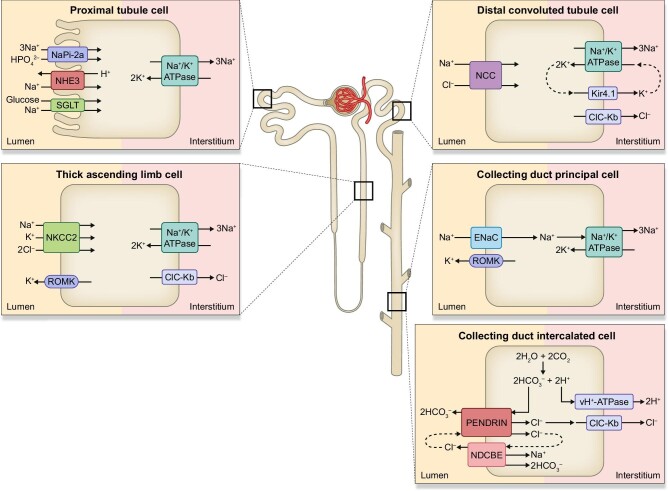
Hypertension is one of the major health problems leading to the development of cardiovascular diseases. Despite a rapid expansion in global hypertension prevalence, molecular mechanisms leading to hypertension are not fully understood largely due to the complexity of pathogenesis involving several factors. Salt intake is recognized as a leading determinant of blood pressure, since reduced dietary salt intake is related to lower morbidity and mortality, and hypertension in relation to cardiovascular events. Compared with salt-resistant populations, salt-sensitive individuals exhibit high sensitivity in blood pressure responses according to changes in salt intake. In this setting, the kidney plays a major role in the maintenance of blood pressure under the hormonal control of the renin–angiotensin–aldosterone system. In the present review, we summarize the current overview on the molecular mechanisms for modulation of blood pressure associated with renal ion channels/transporters including sodium–hydrogen exchanger isoform 3 (NHE3), Na+-K+-2Cl– cotransporter (NKCC2), sodium–chloride cotransporter (NCC), epithelial sodium channel (ENaC) and pendrin expressed in different nephron segments. In particular, recent studies on experimental animal models with deletion of renal ion channels led to the identification of several crucial physiological mechanisms and molecules involved in hypertension. These findings could further provide a potential for novel therapeutic approaches applicable on human patients with hypertension.